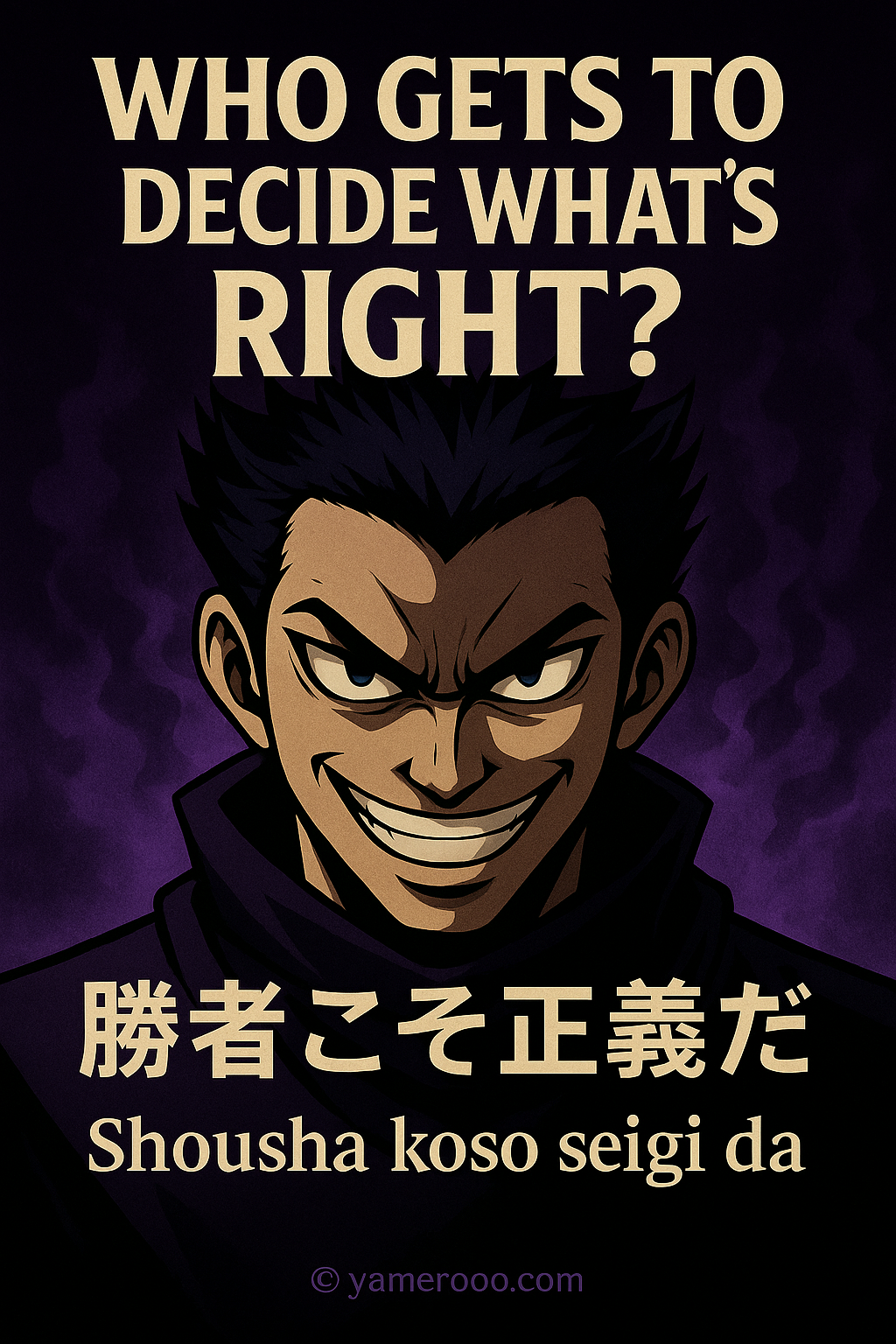
Dark Hero Lesson #4: Have You Ever Noticed How the Winner Always Sounds Right?
When you watch the news, follow online debates, or even just listen to a fight between friends,
have you ever noticed that the “winner” automatically sounds more right?
The loser’s reasons, feelings, or excuses are usually cut short, edited out, or simply ignored.
In Japanese, there is a phrase that perfectly captures this dark but very real idea:
勝者こそ正義だ。
Shousha koso seigi da.
“The winner is the one who gets to be justice.” / “The winner gets to decide what is right.”
In this Dark Hero lesson, we’ll explore this phrase with our Villain and Hero.
You’ll learn not only the language, but also the nuance and the uncomfortable questions behind it.
1. Dark Hero’s Opening Line:勝者こそ正義だ

勝者こそ正義だ。
Shousha koso seigi da.
The winner is the one who gets to be “justice.”
※ こそ(koso)は「こそぞ」と強く言い切るイメージ。
“and that’s exactly who is right” という強調。
The Villain is not just saying “winners are good people.”
He is making a much colder claim:
- Whoever wins gets to write the story.
- Whoever controls the story gets to define right and wrong.
This is close to the English idea: “History is written by the victors.”
In Japanese culture, there is also a related proverb:
勝てば官軍(かてばかんぐん)。
Kateba kangun.
“If you win, you are the government army.” (The winner is treated as the legitimate side.)
2. How This Idea Shows Up in Everyday Life
You don’t need a war or a revolution to feel this phrase.
You can see “勝者こそ正義だ” at work in many everyday situations:
- Office politics: The project that succeeds is called “the right decision,” while failed ideas are quietly erased.
- School life: The popular student’s opinion dominates; the quiet student’s side of the story disappears.
- Social media: The tweet with more likes and retweets looks more “correct,” even if the story is one-sided.
- Arguments: The person who speaks louder and wins the argument is seen as the rational one, even if both were wrong.
In conversations, Japanese people might not always say the phrase out loud,
but the logic is there: “Well, in the end, the one who wins is right.”
Here is how someone might comment, half joking, half serious:
3. Hero Pushes Back(少しだけ)
Our Hero doesn’t fully accept the Dark Hero’s worldview.
He can’t deny the reality, but he doesn’t want to let it be the only truth.

たしかに、勝った側の話だけが残ることは多いよ。
Tashika ni, katta gawa no hanashi dake ga nokoru koto wa ooi yo.
You’re right, the winner’s story is the one that usually survives.
でもさ、それって本当に「正義」って呼べるのかな?
Demo sa, sorette hontou ni “seigi” tte yoberu no kana?
But… can we really call that “justice”?
Hero is not denying the power of winning.
Instead, he’s asking a question directly to you:
When you hear only the winner’s version of the story, do you automatically trust it?
Or do you stop and wonder, “What is missing here?”
4. Nuance of「勝者こそ正義だ」:冷たさと皮肉
Let’s look more closely at the nuance of the phrase itself.
4-1. Grammar and feeling
勝者こそ正義だ。
Shousha koso seigi da.
- 勝者(しょうしゃ) – shousha – “winner”
- こそ – koso – strongly emphasizes “and that one exactly”
- 正義(せいぎ) – seigi – “justice”
The phrase sounds sharp, cynical, and a bit dark.
It often appears in anime, manga, games, and dramas when a character has a harsh view of the world.
In real-life conversation, people might say it jokingly, with a bitter laugh:
「世の中、勝者こそ正義だからね。」
Yo no naka, shousha koso seigi dakara ne.
“That’s how the world works – the winner gets to be ‘justice.’”
4-2. Is the speaker agreeing with it?
Important point: when Japanese speakers use this phrase, they are not always saying:
“And that’s a good thing!”
Often, they are doing one of these:
- 冷めた観察:“Like it or not, this is reality.”
- 皮肉・批判:“It’s unfair that the world works like this.”
- 開き直り:“So I’ll just focus on winning, even if it feels wrong.”
Our Dark Hero leans toward the third one: he chooses to accept the rule and use it.
5. Question for You:Whose Story Do You Believe?
Let’s bring this back to you, the reader.
Think about the last “story” you believed:
a news headline, a viral tweet, a YouTube drama, a rumor at school or work.
- Did you hear only the winner’s side?
- Did you have a chance to listen to the loser’s story?
- Did the winner sound “right” because they had more power, more followers, or better PR?
The phrase 「勝者こそ正義だ」 forces you to notice this power imbalance.
You don’t have to agree with it.
But once you see it, it’s hard to unsee.
6. Useful Phrases:Agreeing, Questioning, and Pushing Back
Here are some phrases you can combine with 勝者こそ正義
to express your attitude in Japanese.
6-1. Bitter agreement(現実として受け止める)
「結局、勝者こそ正義って感じだよね。」
Kekkyoku, shousha koso seigi tte kanji da yo ne.
“In the end, it really feels like the winner gets to be ‘justice.’”
「きれいごと抜きで言えば、勝者こそ正義なんだろうね。」
Kireigoto nuki de ieba, shousha koso seigi nandarou ne.
“If we drop the pretty words, the winner is probably the one who gets to be ‘justice.’”
6-2. Questioning and doubting
「でもさ、勝者こそ正義って考え方、ちょっと怖くない?」
Demo sa, shousha koso seigi tte kangaekata, chotto kowakunai?
“But hey, isn’t the idea that ‘the winner is justice’ kind of scary?”
「負けた側の話も聞かないと、本当の正義は見えないよ。」
Maketa gawa no hanashi mo kikanai to, hontou no seigi wa mienai yo.
“If you don’t listen to the loser’s side, you’ll never see real justice.”
6-3. Dark Hero-style resolution
「世界がそう決めるなら、俺は勝ってから文句を言う。」
Sekai ga sou kimeru nara, ore wa katte kara monku o iu.
“If that’s how the world works, I’ll win first—and complain later.”
7. Mini Practice:Which Side Are You On?
Read the situations below and try to write a short reaction in Japanese using
勝者こそ正義 or the related phrases.
-
A game company releases a buggy game, but it still becomes a huge hit.
Everyone calls it “a masterpiece” because it sold well. -
In a school election, the more popular student wins.
The other candidate had better ideas but no support. -
On social media, the person with more followers wins the argument,
even after sharing incorrect information.
Example answer:
「売れたもん勝ちって、まさに勝者こそ正義って感じだね。」
Ureta mon gachi tte, masani shousha koso seigi tte kanji da ne.
“‘Whoever sells more wins’ is exactly what ‘the winner is justice’ feels like.”
8. Summary:Learning the Phrase Without Losing Yourself
勝者こそ正義だ。
Shousha koso seigi da.
- It describes a world where power decides what is “right.”
- It often carries cynical or critical nuance in Japanese.
- You can use it to explain reality—but you don’t have to agree with it.
The Dark Hero accepts this rule and uses it.
The Hero sees the same reality, but quietly asks:
Next time you hear a “winner’s story,” try listening with this phrase in mind.
You’ll not only improve your Japanese nuance, but also see the hidden structure of many real-world dramas.