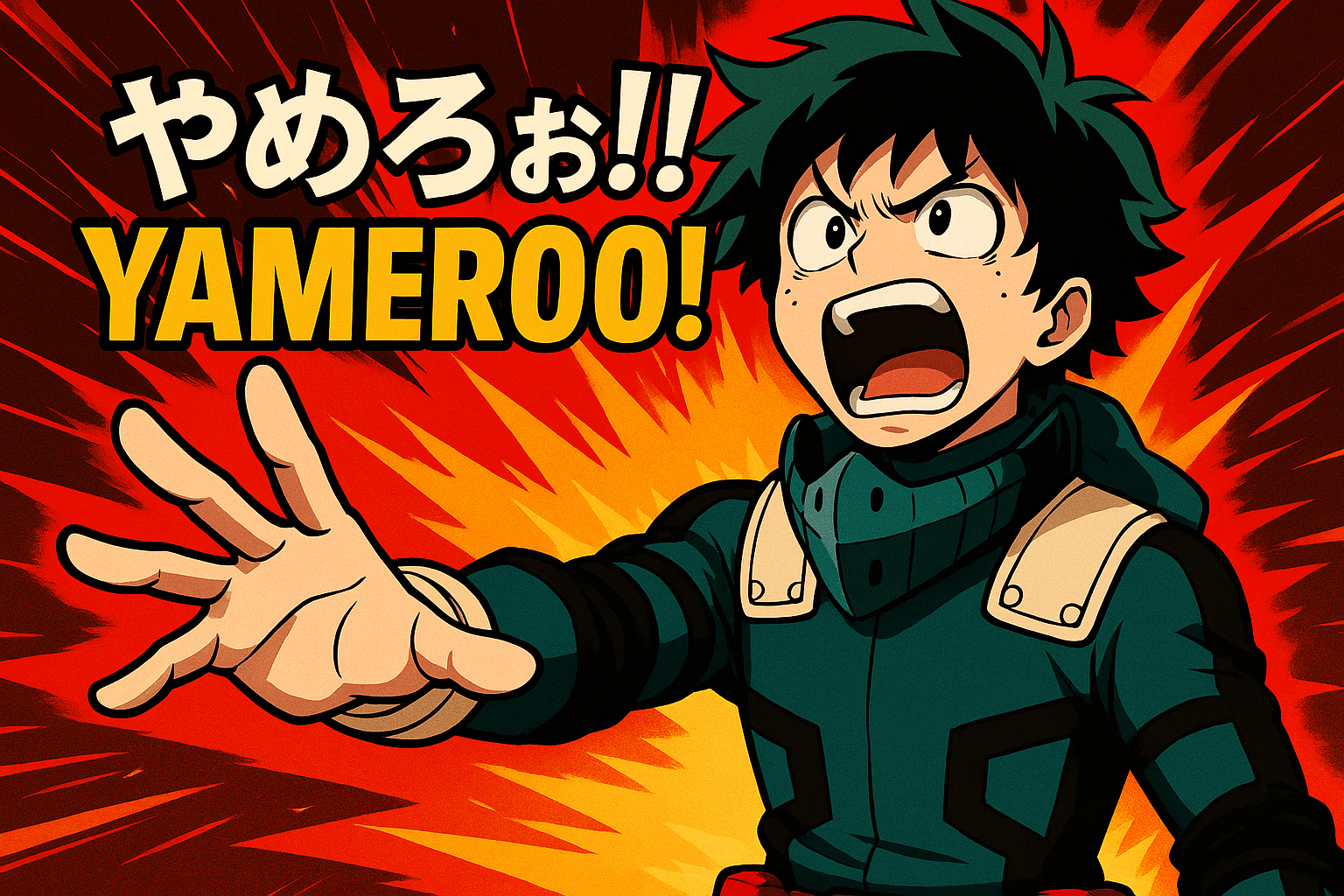
Yamero! I won’t let you hurt anyone else!
There’s a classic anime moment: a hero steps forward, puts themselves between danger and their friends, and yells a raw, emotional “Stop!”. Not polite. Not calm. Just a protective shout that says, “This ends here.”
In Japanese, one dramatic line that captures that exact vibe is:
やめろー!これ以上みんなを傷つけさせない!
Yameroo! Kore ijou minna o kizutsukesasenai!
“Stop! I won’t let you hurt everyone any more!” / “Stop! I won’t allow you to hurt anyone else!”
This lesson is written for learners: English-first (easy to follow), with Japanese + romaji for every key line. And we’ll also talk about a very important point: this phrase is powerful, but it’s not a daily-life phrase.
- 1) Scene: When Someone Is About to Get Hurt (Right in Front of You)
- 2) Phrase Breakdown: What Does It Literally Mean?
- 3) When Can You Use This Phrase?
- 4) The “Misunderstanding Zone” (誤解ゾーン): Common Learner Mistakes
- 5) Nuance: What Kind of “Stop” Is This?
- 6) Mini Dialogue Variations (Same Meaning, Different Heat)
- 7) Practice Time (with Answer Key)
- 8) Summary: Learn the Line—Then Choose Your Level
1) Scene: When Someone Is About to Get Hurt (Right in Front of You)
You use this kind of line when the danger is immediate: someone is about to get hurt right now, and you’re trying to stop it with force and emotion. That’s why it shows up so often in anime, games, and dramatic stories.

Yameroo! Kore ijou minna o kizutsukesasenai!
Stop! I won’t let you hurt everyone any more!

Minna o mamoru tame nara, koko de tomeru.
If it’s to protect everyone, I’m stopping this right here.
Notice the emotional contrast: Heroine is bold and explosive—she shouts first. Hero is calm but firm—he confirms the boundary. Together, they create that “protective wall” feeling that anime fans love.
2) Phrase Breakdown: What Does It Literally Mean?
Let’s break it down so you can feel why it sounds so strong.
2-1) やめろー!(Yameroo!)
やめろ is the imperative form of やめる (“to stop”). In daily life, imperatives can sound rough or aggressive. In anime, this roughness is part of the emotional “impact.”
やめろー!
Yameroo!
“Stop it!” / “Cut it out!” (very direct, emotional)
2-2) これ以上 (kore ijou) = “any more / any further”
これ以上
kore ijou
“any more,” “any further,” “beyond this point”
This phrase adds a clear boundary: “Up to now was already too much—no more.”
2-3) The key verb: 傷つけさせない (kizutsukesasenai)
This is the part learners usually struggle with—so we’ll go slowly.
- 傷つける — kizutsukeru — to hurt (someone)
- 傷つけさせる — kizutsukesaseru — to make/let (someone) hurt (someone)
- 傷つけさせない — kizutsukesasenai — won’t let (someone) hurt (someone)
So the emotional logic is:
Kore ijou minna o kizutsukesasenai
“I will not allow you to hurt everyone any more.”
3) When Can You Use This Phrase?
This is the section you pointed out—and you’re right to check it. If a heading says “When can you use this phrase?” the article must clearly answer it. So here it is, clearly:
3-1) ✅ Good places to use it
- Anime-style storytelling: comics, fan art captions, dramatic scripts, roleplay.
- Emotional fiction writing: when someone protects others from harm.
- Strong rhetorical emphasis: a speech or monologue where the tone is intentionally dramatic.
3-2) ❌ Where it sounds unnatural
- Casual daily life: someone took your snack, or your friend teased you.
- Workplace conversation: it’s too emotional and too “command-like.”
- Small conflicts: it can sound like you’re acting in a movie.
If you want a “daily Japanese” version, soften it. Here are two natural options:
もうこれ以上、誰も傷つけたくない。
Mou kore ijou, dare mo kizutsuketakunai.
“I don’t want anyone to get hurt any more.”
やめて。これ以上はダメ。
Yamete. Kore ijou wa dame.
“Stop. That’s enough.” (simple, very usable)
4) The “Misunderstanding Zone” (誤解ゾーン): Common Learner Mistakes
Now, let’s do the AdSense-friendly “clear learning value” part: the misunderstanding zone. These mistakes are extremely common, especially if you translate word-by-word.
4-1) Mistake #1: Thinking “やめろ” is always okay
In anime, やめろ can sound heroic. In real life, it can sound harsh—like you’re ordering someone. If you want to sound polite or normal, use: やめて (yamete).
Genjitsu de iu nara, “yamete” no hou ga anzen da yo.
In real life, “yamete” is the safer choice.
4-2) Mistake #2: Confusing “hurt” vs “make/let someone hurt”
English “hurt” is simple. Japanese can show “who causes it” more clearly. That’s why 傷つけさせない is powerful: it’s not only “hurt,” but “I won’t allow you to do it.”
Quick feeling check:
傷つける = direct action (“hurt”).
傷つけさせる = permission/causation (“make/let hurt”).
傷つけさせない = refusal to allow (“won’t let hurt”).
4-3) Mistake #3: Using “みんな” too casually
みんな (“everyone”) is emotional and dramatic here. If you’re talking about one person, you can change it:
やめろ!これ以上あの子を傷つけさせない!
Yamero! Kore ijou ano ko o kizutsukesasenai!
“Stop! I won’t let you hurt that kid any more!”
5) Nuance: What Kind of “Stop” Is This?
English has many “stop” lines: “Stop it,” “Don’t,” “Enough,” “Cut it out,” “Back off.” Japanese also has many, and each carries a different emotional temperature.
5-1) Strong and dramatic (anime energy)
- やめろ! (yamero) — command, rough
- ふざけるな! (fuzakeru na) — “Don’t mess with me!”
5-2) Strong but usable (real-life emotional)
- やめて! (yamete) — direct, common
- もうやめて! (mou yamete) — “Please stop already!”
5-3) Calm boundary (adult, firm)
- そこまで。 (soko made) — “That’s enough.”
- これ以上はダメ。 (kore ijou wa dame) — “No more than this.”
6) Mini Dialogue Variations (Same Meaning, Different Heat)
Let’s practice changing the “heat level” while keeping the meaning.
Yameroo! Kore ijou minna o kizutsukesasenai!
(Max drama) Stop! I won’t let you hurt anyone else!
Yamete. Kore ijou wa dame da.
Stop. That’s enough.
Mou dare mo kizutsukanaide.
Please don’t hurt anyone anymore.
Same core idea. Different temperature. This is the skill that makes your Japanese sound natural: choosing a line that matches the scene.
7) Practice Time (with Answer Key)
7-1) Fill in the blanks
Choose the best verb form: 傷つける / 傷つけさせる / 傷つけさせない
-
You want to say: “Don’t hurt my friend.”
友だちを ______ な。
Tomodachi o ______ na. -
You want to say: “He let them hurt her.”
彼は彼女を ______ しまった。
Kare wa kanojo o ______ shimatta. -
You want to say: “I won’t let you hurt anyone else.”
もう誰も ______ ようにはさせない。
Mou dare mo ______ you ni wa sasenai.
7-2) Answer Key
-
友だちを 傷つける な。
Tomodachi o kizutsukeru na.
“Don’t hurt my friend.” -
彼は彼女を 傷つけさせて しまった。
Kare wa kanojo o kizutsukesasete shimatta.
“He ended up letting them hurt her.” -
もう誰も 傷つけさせる ようにはさせない。
Mou dare mo kizutsukesaseru you ni wa sasenai.
“I won’t let them hurt anyone anymore.”
Tip: In #3, you see “させない” twice (傷つけさせる → させない). It’s like a double-lock: “I won’t allow the ‘letting happen.’”
8) Summary: Learn the Line—Then Choose Your Level
Let’s lock in the core phrase one more time:
やめろー!これ以上みんなを傷つけさせない!
Yameroo! Kore ijou minna o kizutsukesasenai!
“Stop! I won’t let you hurt anyone else!”
- Best for: anime-style dramatic scenes, protective moments, storytelling.
- Key grammar: 傷つける vs 傷つけさせる vs 傷つけさせない.
- Daily-life option: やめて。これ以上はダメ。 (Yamete. Kore ijou wa dame.)
Oboeru dake janakute, bamen ni awasete “ondo” o erabou.
Don’t just memorize it—choose the right “heat level” for the situation.